INTRODUCTION
Welcome to Parent Academy!
The Parent Academy was developed to equip parents or any caregiver of rising kindergarteners with the tools and knowledge to help their child as they prepare for kindergarten.
Parent Academy is made up of eight, interactive, hands-on modules. Each module focuses on a specific skill and provides simple hands-on activities , suggested materials and practical tips that parents or caregivers can use to support their child’s learning and development.
Parent Academy Learning Outcomes
Learning outcomes are often included to inform participants what they will be learning and what they should know or be able to do at the end of the program. Take some time to review the learning outcomes below and at the start of each module.
By the end of Parent Academy participants will be able to:
- Incorporate kindergarten readiness activities into your daily routine.
- Understand the importance of repetition in helping children master new skills.
- Understand the value of adult-child interactions in kindergarten readiness activities.
- Recognize that all children develop at their own pace.
- Identify helpful resources and seek support when concerned about child development.
- Understand that early literacy skills begin before school and that parents/caregivers are a child’s first teacher.
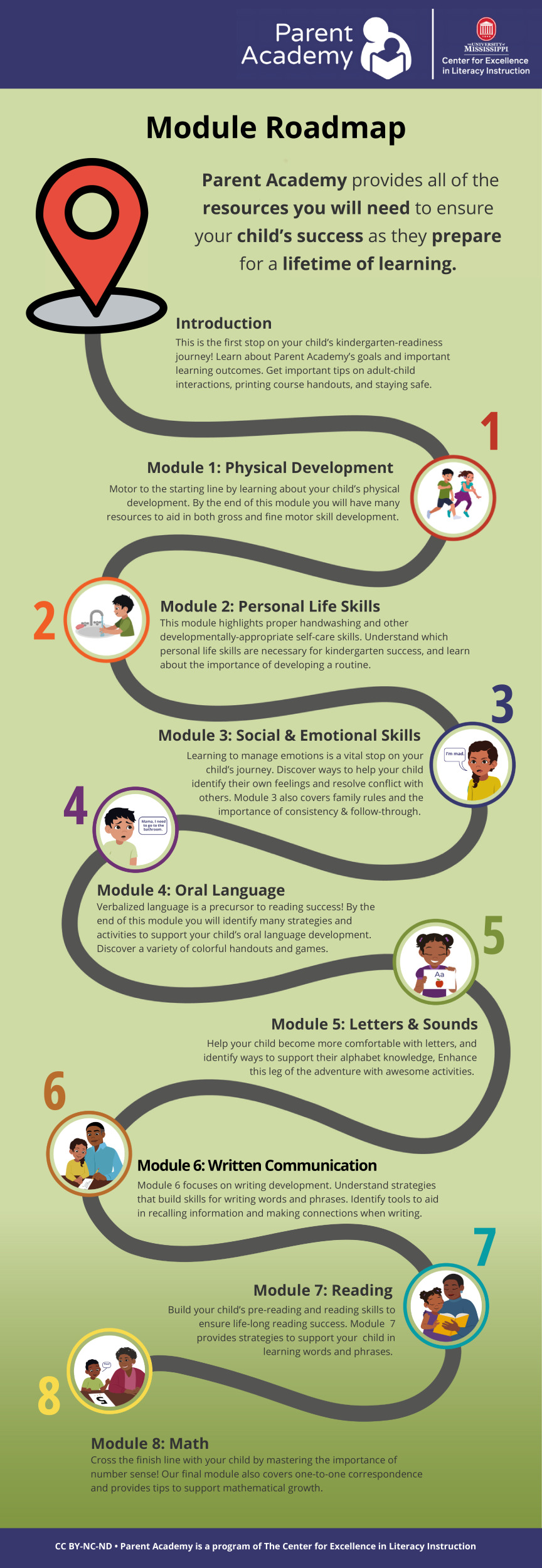
Download the above Course Roadmap infographic.
Understand the importance of adult-child interactions
Learning happens through practice, support and interaction. Every interaction between a child and an adult creates valuable learning opportunities.
You might say, “I’m not a teacher!” but parents and caregivers are a child’s first and most important teachers. Long before school begins, children are learning essential skills through everyday moments and conversations at home.
Through these early interactions, children learn to trust, to become more confident, to develop strong language skills, and learn how to communicate and show respect for others. The more children engage in conversation with adults, the stronger their vocabulary and comprehension become. Parents, caregivers and families are the most important parts of a child’s preparation for kindergarten.
Parent Academy Families
A family is a group of people related by birth, marriage, or adoption. Any person related to you is considered a member of your family. Families can look very different, but all family members usually love and care for each other very much.
Some families may not look like what you typically think of when you hear the word family. However, we understand that families come in all shapes and sizes. These families will help us explain concepts and share how they are getting their children “ready” for kindergarten.
Module Structure and Icons
You will see several ICONS used on this website. Let’s look at them so that you can be familiar with them.
You will see the “What does it look like?” ICON  at the beginning of modules or sections. It gives you a list of things that your child will be able to do when that skill is mastered.
Sometimes you will see the “Supplies” ICON  at the beginning of an activity description. You will find the list of materials needed to complete the activity. If you attended the in-person sessions, many of the materials or supplies were provided for you.
When you see a note with a push pin like this  , there will be a phrase or sentence that we want you to remember.
Have Fun Remember to Be Safe!

The activities in these modules are designed to be, hands on ways for you to support your child’s development. Remember that they are designed to be done together, always with your supervision. Some of the activities use small items such as beads, that could pose safety issues if left unattended. Because 3 and 4 year olds often out things in their mouths, it is important to keep these materials out of reach when not in use.
Another fun activity to keep an eye on is cutting with scissors. Learning to use scissors is an important skill, but it also requires close supervision. Always teach and model safe cutting habits.
Here are a few tips:
- Always supervise your child during activities.
- Use safety scissors that are made for children and have rounded or blunt tips.
- Explain that scissors are used for cutting paper only (not clothing, hair, or books).
- Remind them that they should always sit while using scissors and never run.
- Store scissors with blades down and out of reach when they are not being used.
- One last thing, have fun learning together and be safe!
A Note on Printing Handouts
Each module includes downloadable handouts you can save or print for reference. If you choose to print them, be sure to select the “Fit to Page” option. This prevents the edges from being cut off. Most printers have at least a 1/4 inch border around the paper where it cannot print ink.
Summary
All children develop at different paces, so if your child isn’t where their siblings were at this age, or isn’t where a friend’s child is—be patient. However, if there are some major red flags, or you think there is a problem, feel free to consult with your child’s pediatrician and they can help you find the right resources.
Remember, learning occurs long before your child enters a school building. You are your child’s first teacher, and our Parent Academy will provide you with content and equip you with activities to support your child’s development and get “ready” for kindergarten. So, let’s get started and get your child kindergarten ready!